
A friend of mine once tried bungie jumping. Standing on a high bridge, the next guy up stepped forward so that the Instructor could attach the harness and bungie cord for his jump. For a ‘Laugh’ the Instructor started to attach the cord around his neck, no doubt expecting the guy to object and see the ‘joke’. In this case the guy didn’t object at all and seemed quite prepared to jump. Perhaps it was because he had implicit trust in the Instructor, or maybe he didn’t know any better ! Which ever, it goes to show how reliant you are on the ‘experts’ when starting out in a new sport.
Skiing is no exception. As a learner you are confronted with lots of unfamiliar equipment and you rely on the experts from the hire shop to set it up correctly for you. If the ‘experts’ mess up, or are maybe not expert at all, you could be at risk. A group of friends recently went on holiday and hired skis and boots from the local hire shop. On the first morning one of them fell, suffering a knee injury after the skis failed to come off.
The problem was incorrectly calculated settings for their ski bindings. On a hunch I checked the ‘shop’ settings for their ski bindings against the industry standard charts. For each person the shop had set them too high, making it harder for the ski’s and boots to separate in the event of a fall. Appalling service from so called experts.
This could happen to you, but it’s simple to avoid.
Ski bindings are adjusted according to a "DIN" value so that your skis and boots separate in the event of a fall. The idea is to reduce the chance of leg and knee injuries. Your DIN value is calculated from information including your weight, height, the sole length of your ski boot, how aggressively you ski and your age. DIN settings are an international standard and are transferable between different makes of Alpine ski bindings.
Because DIN values are an industry standard there are lots of charts and spreadsheets available online to make working out your own personal DIN setting quick and simple. Once you know your DIN setting you can give it to the shop each time you hire (or buy) ski’s so that they can set them correctly. As a precaution double check visually that they have been set as requested before you leave the shop. Expect the front \ rear \ left \ right settings to be the same. If in doubt have them double checked by a qualified expert.
Try this link for DIN Charts: http://www.dinsetting.com/dinchart.htm
DISCLAIMER: This article is for information only. Always have your bindings checked and adjusted by a professional.

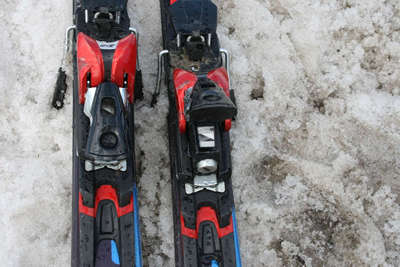
I think when it comes to ski bindings the most obvious setting of ski binding is the Indicator on the toe and heel. The indicator has a sliding gradient scale whose numbers relate to the tension setting of the binding.
ah, but what value to to set them too ? 😉